.svg)
%201.svg)

%201.svg)

.svg)

There is a pattern I have watched unfold across dozens of mass timber projects over the years. The structural engineers complete their drawings. The fabrication schedule gets locked in. And then, somewhere in the final stretch before construction, someone asks: "What finish are we using on the wood?"
By that point, the answer tends to be whatever can be specified quickly.
This approach feels practical. It is also where many coating failures begin.
What Happens When the Finish Becomes an Afterthought
In my experience working with architects, engineers, and contractors across the country, mass timber coating failures tend to trace back to a common pattern: the finish was specified late in design by someone unfamiliar with the particular wood product or its exposure conditions. The result is often a generic specification calling for an "exterior wood stain" without accounting for whether the project uses glue-laminated timber (glulam), cross-laminated timber (CLT), or mass plywood panels. Each of these materials behaves differently. A penetrating oil-based stain that performs beautifully on one substrate might fail on another.
When coatings are left to the end, critical application details get delegated to the contractor's discretion. Performance testing in realistic conditions either happens too late or not at all. The wood's protection becomes secondary to the construction schedule.
The consequences are measurable. I have seen projects where untreated mass timber achieved only a Class B or C flame-spread rating in ASTM E84 tests, falling short of code requirements for interior finishes. A proper fire-retardant coating can elevate wood to Class A, but only if it is planned early enough to be part of a tested system. Building officials will only accept fire rating test reports that match the exact wood substrate, coating product, application thickness, and surface preparation used on the project. If those elements are not coordinated until late in the process, the project faces delays or costly retrofits.
The Moisture and Aesthetic Risks You Cannot Undo
Beyond fire performance, late coating decisions create moisture and UV exposure problems that are difficult or impossible to correct after the fact.
Mass timber is hygroscopic. It absorbs and releases water with the environment, causing swelling, shrinkage, and potentially rot or mold if exposure is prolonged. Most CLT and glulam manufacturers do not pre-treat wood with preservatives because these chemicals can interfere with adhesives during production. That means the project team must plan external protective measures.
When specifications only vaguely note that wood "shall be protected" without defining how, field teams are left to improvise. Wood surfaces get soaked or stained during construction. Iron stains from tools, watermarks from rain exposure, and UV discoloration can set in before the building is even enclosed. Some of these stains are extremely difficult to remove later. I have spoken with architects who were dismayed to see their timber structure turn blotchy or gray months before occupancy, all because a proper coating was not chosen in time.
The aesthetic outcome suffers too. The color or gloss of a finish might look different on the actual wood species than expected, or clash with the lighting in the space. In mass timber construction, the wood itself is a major visual element, akin to a finish material. A misstep in coating choice can undermine the entire design intent.
Why Early Specification Changes Everything
The alternative is straightforward in principle, though it requires a shift in how project teams think about sequencing: specify the coating system early, ideally before or alongside the structural design.
When architects, engineers, and coating specialists collaborate from the start, wood protection and appearance become fundamental design parameters rather than afterthoughts. The benefits compound throughout the project lifecycle.
Protecting the investment from day one. Owners choosing mass timber are making a substantial investment in exposed wood. Selecting an appropriate coating system early, and ideally applying it in a controlled factory setting, safeguards the timber through manufacturing, shipping, construction, and beyond. This proactive step ensures the wood's appearance is not ruined by construction stains or moisture damage that would require costly repairs or member replacement.
Integration with fabrication and construction planning. Early specification allows the coating process to be integrated into the project's overall production schedule. Factory pre-finishing of timber elements is becoming a best practice in the industry. When the coating is chosen in time, wood suppliers or fabricators can apply initial protective treatments to all six sides of each member, including the crucial end-grain, under optimal conditions. In a controlled environment, coatings go on at the right thickness, temperature, humidity, and light conditions for a consistent finish. By contrast, if you wait until after structural installation, you might be applying stain to overhead beams 40 feet in the air, in less than ideal conditions.
Achieving the aesthetic outcome you actually want. When coatings are considered before final drawings, architects have the opportunity to dial in the exact appearance they envision. Wood species, grain, and coating interact in complex ways. An advantage of early specification is the ability to create sample finishes on the actual wood stock that will be used, and to view them under realistic lighting conditions. Design teams can experiment with different stain formulas, pigments, or clear coats until the color and transparency are right.
What the Portland International Airport Taught Us About Coatings-First Design
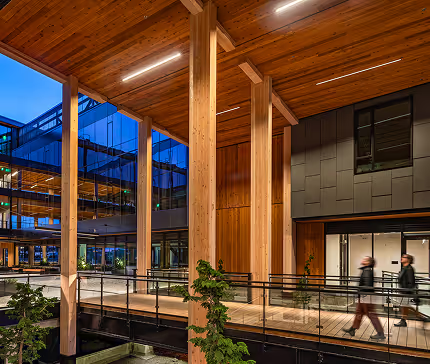
One of the clearest examples of this approach in practice is the Portland International Airport terminal expansion. The project features one of the largest mass timber roof structures in the United States: 2.5 million board-feet of Douglas fir glulam beams forming a 9-acre undulating ceiling.
%20(1).jpg)
From the outset, the design team at ZGF Architects recognized that this signature roof's success depended on the long-term beauty and durability of its exposed wood. They took an unusual step: engaging the coating manufacturer at the very start of design.
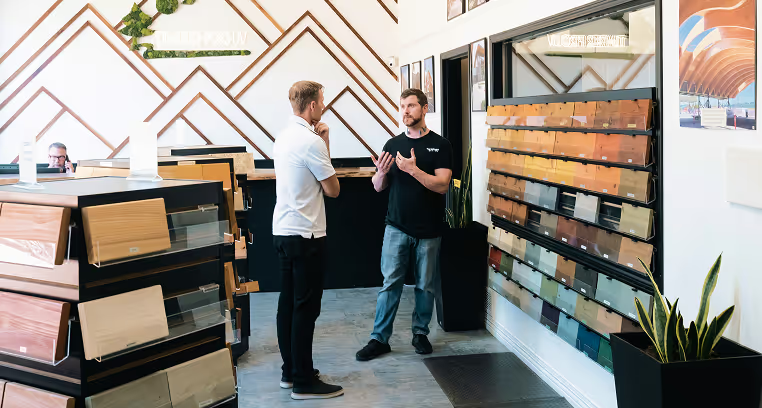
Our team at Timber Pro Coatings was brought in early to consult on the finish system. On the project's first design visit to our showroom, the architects met directly with our company president, Shari Steber, to discuss goals and challenges. This led to an iterative, hands-on development process.
We formulated and tested twelve different color and pigment variations of stain on sample glulam pieces. The team then pre-stained large mock-up panels and physically brought them to the airport site, installing them in situ to observe how the color looked under the terminal's actual lighting conditions. Only after this rigorous testing and mock-up approval did the final coating specification get locked in, well before mass timber fabrication began.
The chosen system was a custom "PDX White" stain, using our LSS Formula Microtint Series penetrating stain and sealer with a clear topcoat. Because coatings were specified early, the massive glulam beams could be pre-finished off-site. Each beam received the stain and sealer before installation, ensuring consistent coverage and protection on every surface.
Over 8,000 gallons of eco-friendly wood finish were applied for this project, a scale that demands careful coordination. Thanks to early planning, the coating was applied under controlled conditions and had fully cured by the time the beams were erected.
%20(1).jpg)
The benefits became evident as construction proceeded. That summer, Portland saw record heat waves reaching up to 120°F, followed by typical Pacific Northwest rain. The pre-applied coatings protected the wood through it all, preserving the natural grain and color without blotching or degradation. Had the beams been left raw during those months, they could have warped or discolored badly.
This investment in early collaboration pays dividends that compound throughout construction. When the coating is chosen with full understanding of the wood species, grain, and exposure before finalizing structural plans, potential problems get solved on paper and in the lab rather than in the field or after project completion.
Technical Considerations for Early Coating Specification
For architects and specifiers considering a coatings-first approach, several technical factors warrant attention during the design development phase.
Match the coating to the specific timber product. Different wood species and fabrication methods affect absorption and finishing. Douglas fir glulam has a smooth planed surface, while CLT panels might have more absorbent sanded faces or rough-sawn textures. Fire rating tests have shown that a coating achieving Class A on plywood might not achieve it on CLT or glulam. Each combination needs evaluation.
Analyze exposure conditions thoroughly. UV protection is critical for any exterior or sun-exposed wood to prevent discoloration. High-moisture areas like indoor pool halls or open-air pavilions may need more robust sealer layers. If the wood will be touched frequently, a harder topcoat can guard against oils and dirt from hands.
Prioritize breathable, penetrating coatings. For most mass timber applications, vapor-permeable finishes allow the wood to breathe and accommodate natural shrink-swell cycles. They are less likely to crack or peel over time compared to film-forming coatings that can trap moisture.
Plan the factory versus field application sequence. Factory finishing is highly recommended for at least the first protective coat. It yields more uniform coverage, especially on end-grain cuts that readily absorb water if unsealed. Many mass timber fabricators now offer this service as part of their scope. Field-applied coats can then be limited to final aesthetic treatments or touch-ups after installation.
The Conversation Worth Having Early
Mass timber offers considerable rewards in speed, sustainability, and beauty, but it also introduces unique risks if the wood is not properly protected. Those risks are entirely manageable with foresight and planning.
.jpg)
In practice, coatings become your best friend or your biggest headache. The difference lies in when and how you address them. Forward-thinking teams are making the coating specification an integral part of design development, and in doing so, they ensure their wood structures remain safe, sound, and visually striking for decades.
If you are working on a mass timber project and want to explore what a coatings-first approach might look like for your specific application, our team at Timber Pro Coatings offers consultations to help you develop a custom coating solution tailored to your wood species, exposure conditions, and aesthetic goals. We find that these conversations are most valuable when they happen early, before the structural drawings are finalized, when there is still room to integrate the finish into the overall project strategy.
The wood deserves that level of care. So does your project.
Get coating support for your next mass timber project
Fill out the form below to schedule a personalized consultation with our commercial team. We'll help you identify the right TimberPro solutions for your specific application.
Speak with a consultant
M-F 9AM - 5PM PST, Saturday & Sunday Closed
%20(1).jpg)
%20(1).jpg)
.svg)
%20(1).avif)
%201.svg)
%201.svg)
%201.svg)
%201.svg)
