.svg)
%201.svg)

%201.svg)

.svg)
%20(1).jpg)
When the Port of Portland asked whether their new terminal's mass timber roof could survive 3-4 years of semi-exposed construction on an active airport tarmac, the honest answer was: it depends entirely on how you protect it.
That question, posed early in the PDX Next terminal expansion, captures a challenge many AEC professionals face when specifying mass timber for large-scale projects. The structural engineering tends to get the attention. The coating system tends to be an afterthought. In practice, however, the coating decision often determines whether a mass timber project ages gracefully or becomes a maintenance burden within the first decade.
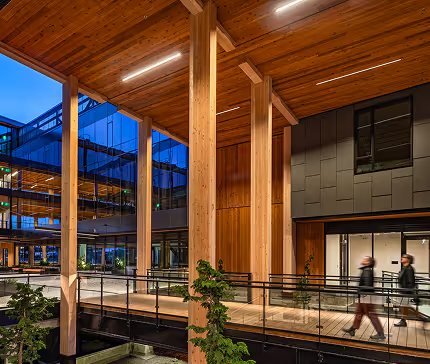
The Portland International Airport project offered us the opportunity to stress-test that principle at an unprecedented scale: 400,000 square feet of Douglas fir, 277 curved glulam beams spanning up to 80 feet, and approximately 8,000 gallons of protective coating. Four years later, the wood still looks brand new.
What follows are the technical considerations and field-tested approaches that made that outcome possible.
%20(1).jpg)
Why Traditional Approaches Fall Short on Large-Scale Mass Timber
Mass timber behaves differently than dimensional lumber. The engineered wood products used in commercial construction, particularly glulam and CLT, present coating challenges that standard exterior stains were never designed to address.
Consider what the PDX roof faced during construction: a 118-degree heat wave lasting several days, followed by Portland winters with sustained high humidity, an unpredictable ice storm, and weeks of wildfire smoke depositing ash across the surface. Add jet fuel fumes from the adjacent tarmac and exhaust from the I-5 freeway, and you have environmental exposure that would test any coating system.
The stakes were considerable. If the beams warped, delaminated, or developed water staining during the multi-year construction window, remediation costs on 277 custom-curved glulam members would have been substantial. More importantly, the aesthetic damage would have been visible to the 35 million annual passengers the terminal was designed to serve.
Standard exterior stains tend to fail in these conditions for a predictable reason: they sit on the wood surface rather than penetrating the substrate. When moisture infiltrates from behind or temperature cycling creates expansion and contraction, the coating lifts, cracks, or clouds. On a project where beams are pre-finished off-site and then transported, lifted, and welded into position, you need a system that can absorb that mechanical stress without visible degradation.
The Two-Coat System That Performed Under Extreme Conditions
The approach we developed for PDX used a two-coat penetrating system with Timber Pro LSS as the foundation. The first coat, a clear LSS formula, served as a primer and sanding sealer to create an even palette across the Douglas fir substrate. This matters because Doug fir, while structurally excellent, tends toward blotchy absorption patterns that become visible under pigmented topcoats.
The second coat applied a custom-developed "PDX White" tint to brighten the wood and add UV resistance without obscuring the natural grain. The color took twelve iterations to get right. The goal was a finish that looked relatively untouched, what we sometimes call a "natural matte" appearance, while providing the performance characteristics needed for the exposure conditions.
The application process deserves attention. Horizon Painting applied the coatings in a large warehouse setting using low-pressure sprayers for the length and width of the curved glulams, then smoothed each pass with large stain pads on extendable handles. This combination, spray application followed by pad finishing, achieves consistent penetration without the runs, drips, or pooling that compromise coating integrity on large-format timber.
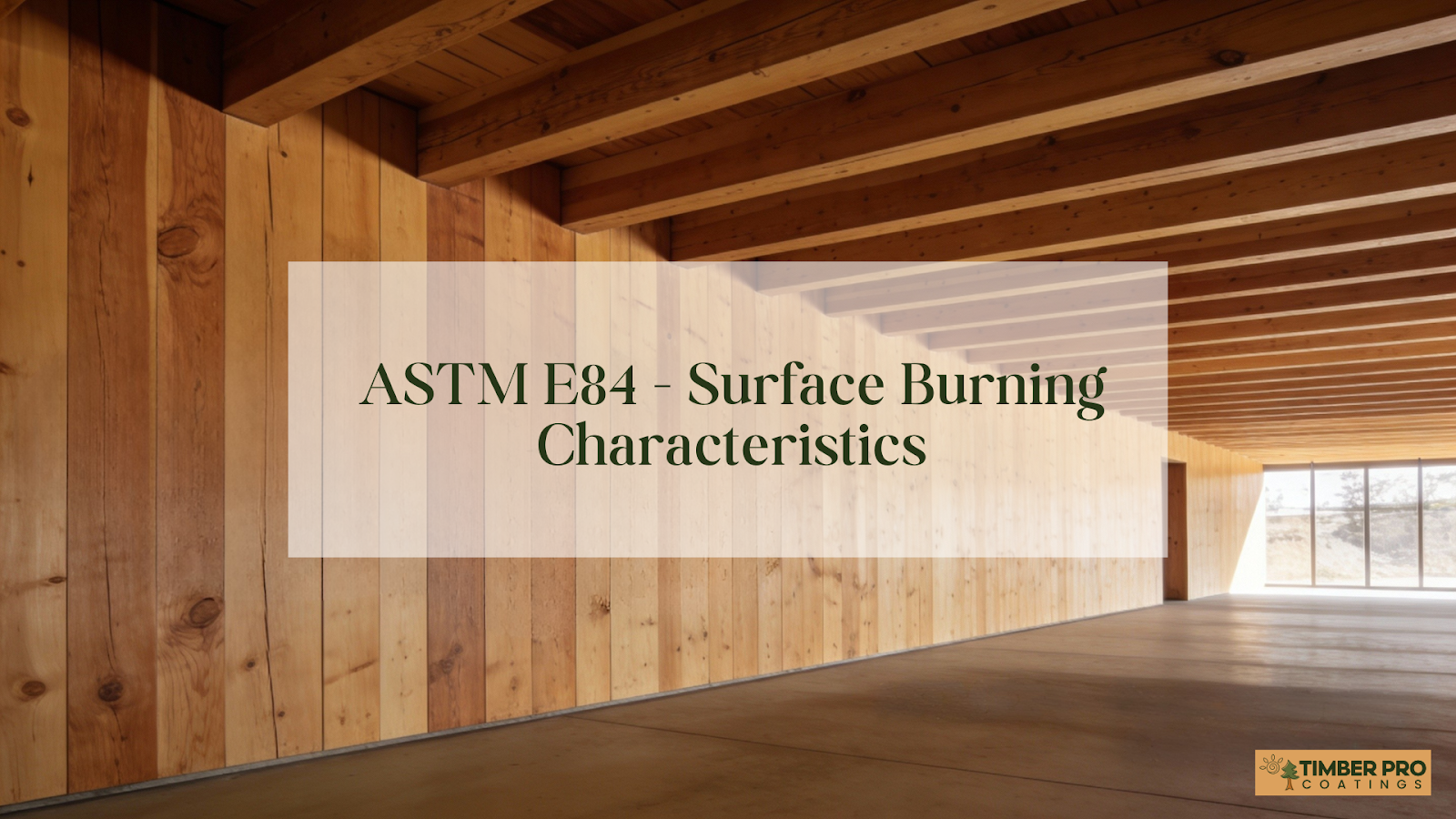
The results speak directly to what AEC professionals need to know: the fire rating achieved was Class B with a flame spread index of 35 and smoke development index of 10. The project earned multiple LEED credits, including MR Credit 6 for Rapidly Renewable Materials, MR Credit 5.1 for Regional Materials, and EQ Credit 4.2 for Low Emitting Materials.
%20(1).jpg)
What Happens When the Coating System Gets Specified Last
In my experience working with mass timber projects across the Pacific Northwest, coating failures trace back to a common pattern: the finish system gets specified late in the design process, often by someone unfamiliar with the specific substrate and exposure conditions.
This creates predictable problems. Generic specifications get written for "exterior wood stain" without accounting for whether the project involves glulam, CLT, or mass plywood panels. Application methods get left to the finishing contractor's discretion. Performance testing against actual job-site conditions either happens too late or not at all.
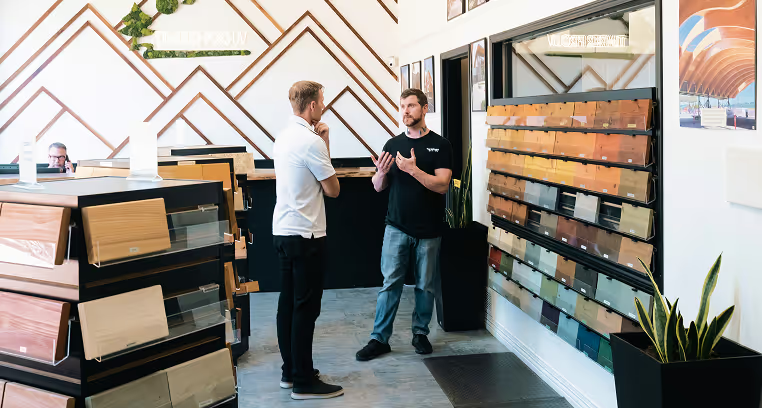
The PDX project took the opposite approach. When the design team first contacted us, we could walk them directly into our showroom. They spoke with the company owner on the first visit. We developed and tested twelve different color and pigment variations before pre-staining large sample panels and bringing them to the airport site for selection under actual lighting conditions.
This investment in early-stage collaboration pays dividends that compound throughout construction. When you understand the specific species, grain pattern, and expected exposure before finalizing the coating specification, you can solve problems that would otherwise emerge during installation or, worse, after completion.
Technical Considerations for Your Next Mass Timber Roof Project
If you are specifying coatings for a mass timber roof structure, interior or exterior, several factors warrant careful evaluation.
Substrate preparation determines outcome quality. Glulam and CLT arrive from fabricators with varying surface conditions. Some have been planed smooth, others show light milling marks, and adhesive squeeze-out at lamination lines creates absorption differences. The coating system needs to accommodate this variability, or you need to specify surface preparation standards in the fabrication contract.
Penetrating systems outperform film-forming finishes on engineered wood. Film-forming coatings, including many exterior deck stains and varnishes, create a surface membrane that eventually cracks or peels under the dimensional changes mass timber undergoes. Penetrating systems bond within the wood fiber itself, which allows the coating to move with the substrate rather than separating from it.
UV exposure matters even on interior applications. The PDX roof includes 49 skylights that cast dappled light through the timber grid. While the UV-resistant glass reduces direct exposure, any mass timber visible to occupants will experience some photodegradation over time. Interior coatings should include UV-blocking formulations, particularly for wood species like Douglas fir that tend toward amber shifts when exposed to light.
Pre-finishing economics favor centralized application. The Timberlab fabrication approach on PDX, where beams were pre-cut, coated, and assembled into 18 giant modules before installation, demonstrates the efficiency of controlled-environment finishing. Weather delays, scaffold access, and quality control all favor pre-finishing over field application when project scale permits.
%20(1).jpg)
The Four-Year Performance Check
The PDX terminal Phase 1 opened on August 14, 2024. At this writing, the wood still looks brand new. No fading. No water staining. The finish held up through transportation and the massive crane lifts required to position 1.4-million-pound roof modules over the existing terminal.
There have been minor touch-up requirements. Some metal staining appeared at connection points where rusting occurred, and tar drips from roofing required cleaning. These were easily addressed with spot treatment rather than system-wide remediation.
The team does not expect to need refinishing except potentially in major skylight areas, and even that is unlikely given the UV-resistant glass specification. For a project that endured four years of extreme environmental exposure before the roof was fully enclosed, this outcome validates the coating system selection.
Protecting What Takes Years to Build
Mass timber projects represent substantial investments of time, engineering expertise, and material resources. The 3.5 million board feet of Douglas fir in the PDX roof came from forests within 300 miles of the airport, sourced through an unprecedented supply chain transparency effort involving tribal partners and community forests. The 277 curved glulam beams required five-axis CNC fabrication at the only regional facility capable of handling such volumes.
Protecting that investment with an inadequate coating specification would be a peculiar economy. The coating cost represents a small fraction of total project value, yet the coating performance determines how the finished structure looks and functions for decades.
At Timber Pro Coatings, we have found that the most successful mass timber projects involve coating consultation early in design development, before substrate selection is finalized and before performance specifications get locked into contract documents. That conversation typically surfaces questions about exposure conditions, aesthetic goals, and maintenance expectations that shape better outcomes downstream.
.jpg)
If you are working on a mass timber project and want to explore coating solutions tailored to your specific conditions, we welcome the conversation. What worked for a 9-acre airport roof may not be precisely what your project requires, but the principles of early collaboration, substrate-specific formulation, and performance testing under actual job conditions apply broadly.
The mass timber industry continues to mature. The coating systems protecting that timber need to mature alongside it.
Get coating support for your next mass timber project
Fill out the form below to schedule a personalized consultation with our commercial team. We'll help you identify the right TimberPro solutions for your specific application.
Speak with a consultant
M-F 9AM - 5PM PST, Saturday & Sunday Closed
%20(1).jpg)

.svg)
%20(1).avif)
%201.svg)
%201.svg)
%201.svg)
%201.svg)
